Apigee is a platform for developing and managing APIs. By fronting services with a proxy layer, Apigee provides an abstraction or facade for your backend service APIs and provides security, rate limiting, quotas, analytics, and more.
High-level architecture
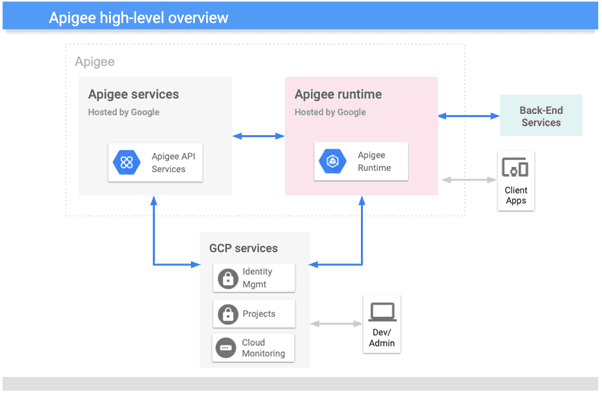
The following image shows the high-level architecture of Apigee:

As the image shows, Apigee consists of the following primary components:
In addition, Apigee uses other components including:
For more detailed explanations, see Components of Apigee.
Here’s a more granular image showing the connection between your Cloud project and Google services over a private peering network:

Apigee enables you to provide secure access to your services with a well-defined API that is consistent across all of your services, regardless of service implementation. A consistent API:
The following image shows an architecture with Apigee handling the requests from client apps to your backend services:

Rather than having app developers consume your services directly, they access an API proxy created on Apigee. The API proxy functions as a mapping of a publicly available HTTP endpoint to your backend service. By creating an API proxy you let Apigee handle the security and authorization tasks required to protect your services, as well as to analyze and monitor those services.
Because app developers make HTTP requests to an API proxy, rather than directly to your services, developers do not need to know anything about the implementation of your services. All the developer needs to know is:
The API proxy isolates the app developer from your backend service. Therefore, you are free to change the service implementation as long as the public API remains consistent. For example, you can change a database implementation, move your services to a new host, or make any other changes to the service implementation. By maintaining a consistent frontend API, existing client apps will continue to work regardless of changes on the backend.
You can use policies on the API proxy to add functionality to a service without having to make any changes to the backend service. For example, you can add policies to your proxy to perform data transformations and filtering, add security, execute conditional logic or custom code, and to perform many other actions. The important thing to remember is you implement policies on Apigee, not on your backend server.
For more information, see Understanding APIs and API proxies.
