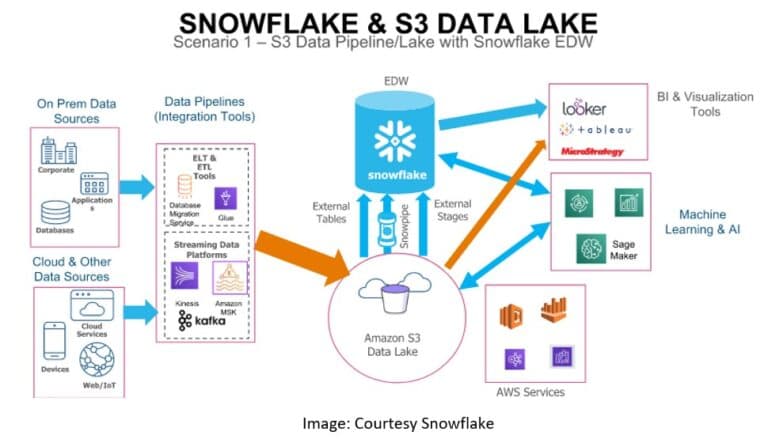

Both platforms are valid and will likely work together in larger enterprises. The tricky part is always access, entitlements and RBAC or TBAC. Across the 2 platforms and related accounts, domains and networks, this is not trivial and needs to be designed up front. A summary of the use cases for AWS S3 Data Lake and Snowflake are below.
AWS S3 Data Lake is a data storage solution where large volumes of data are stored in their raw format. It forms the foundation of a data lake architecture where data can be kept indefinitely at a low cost. You can life cycle manage the data storage to cold archiving retention (glacier).
Snowflake is a cloud-based data platform and data warehouse service that enables data storage, processing, and analytic solutions that are faster and easier to use than traditional offerings.
The choice between AWS S3 Data Lake and Snowflake depends largely on the specific data handling and analysis needs of the organization. For large-scale data storage with flexible processing options, an S3 Data Lake is highly effective. For organizations seeking a powerful, scalable data warehousing solution with minimal management overhead, Snowflake is a strong contender. Often, organizations use both in tandem, utilizing S3 for raw data storage and Snowflake for complex querying and data analysis.
