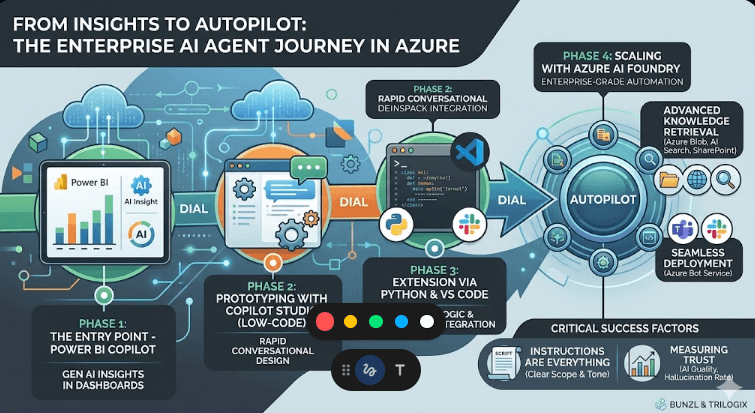

Based on the journey from initial Power BI insights to enterprise-grade automation in Azure AI Foundry.
The transition from viewing AI as a dashboard assistant to deploying autonomous enterprise agents is a journey of increasing technical depth and scalability. By moving through four distinct phases—from Power BI to Azure AI Foundry—organizations can transform repetitive, high-friction tasks into seamless, intelligent workflows.
The journey often begins with Copilot for Power BI, surfacing AI-driven summaries and recommendations directly within existing dashboards. While this proves AI can augment decision-making, it ultimately highlights a larger opportunity: moving beyond surfacing insights to taking action.
To quickly address friction—such as manual SharePoint searches or digging through PDFs—Microsoft Copilot Studio provides an ideal low-code starting point.
The Benefit: Rapidly define topics and connect to data sources without extensive coding.
The Limitation: As logic becomes nuanced and integrations tighten, a purely low-code environment often hits a ceiling, necessitating a move toward professional development.
By introducing custom Python development in VS Code, developers can bridge the gap between simple chat and complex automation. This hybrid approach allows for:
Custom Agent Logic: Precise handling of query parsing and fallback behaviors.
Secure Management: Robust handling of environment variables, API keys, and endpoints.
Workspace Integration: Directly connecting agents to tools like Slack, meeting users where they already communicate.
The final stage of the evolution is migration to Azure AI Foundry, the enterprise platform for managing agent lifecycles at scale.
Foundry’s strength lies in its ability to unify disparate knowledge sources into a clean data pipeline via Azure Blob Storage:
File Search: Queries unstructured internal documents.
SharePoint Integration: Accesses organizational content repositories directly.
Azure AI Search: Provides scalable, semantic search across massive document sets.
Using Azure Bot Services, agents are surfaced in both Microsoft Teams and Slack. This drastically reduces the complexity of managing authentication and channel deployment compared to building custom integrations from scratch.
Technical architecture is only half the battle. The quality of an AI agent is directly proportional to the clarity of its instructions. Well-crafted instructions define the agent’s scope, tone, and escalation paths. Vague instructions lead to unreliable agents; specific, structured encoding of business logic leads to trust.
To maintain enterprise standards, two metrics must be monitored consistently:
AI Quality: Measuring retrieval precision and alignment with user intent.
Hallucination Rate: The most significant risk to enterprise trust. Ensuring the agent never generates information ungrounded in its source documents is non-negotiable.
The progression from dashboard insights to production-ready agents reflects the maturation of the AI space. By leveraging Azure AI Foundry, teams return significant “cognitive load” to their employees, allowing them to focus on strategic work rather than manual data retrieval.
