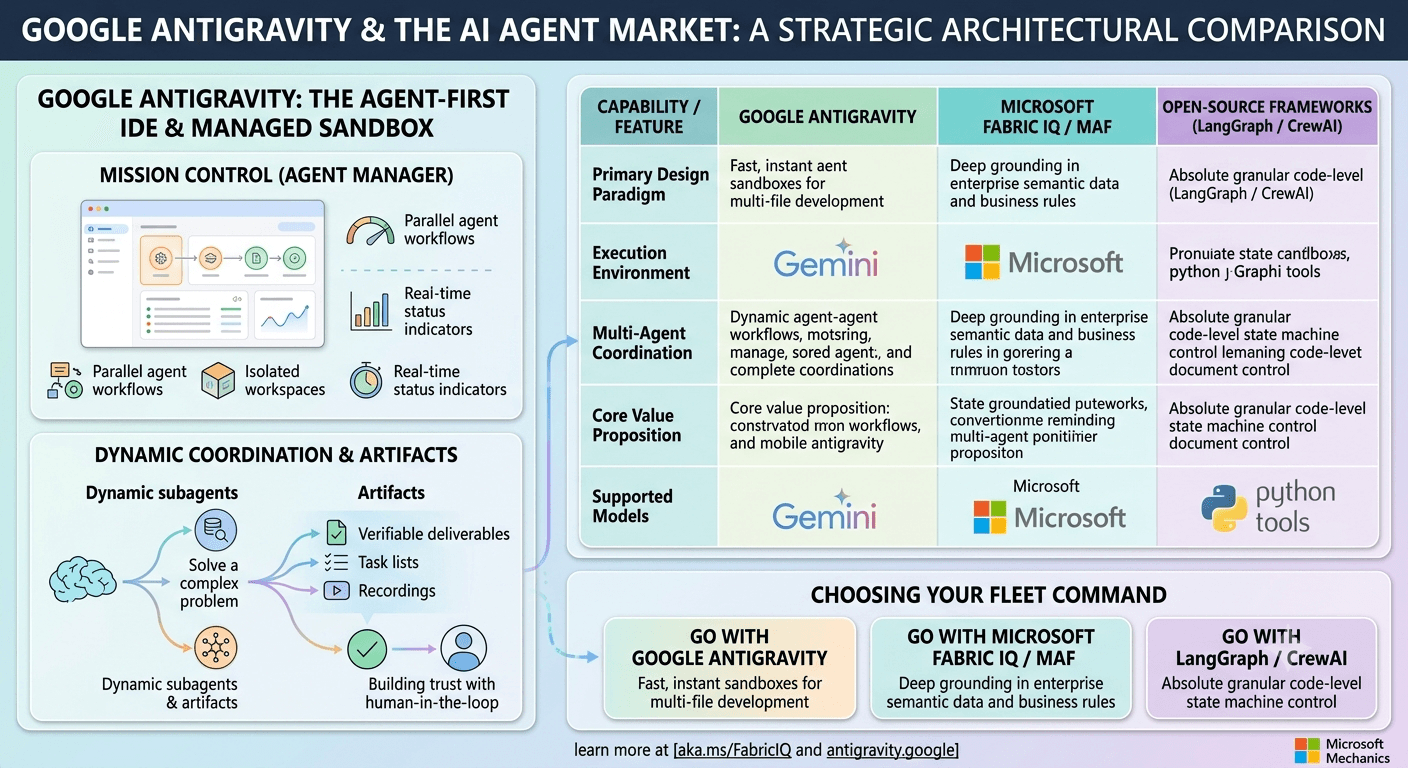

The tech landscape has officially passed the era of “AI as an autocomplete box.” We are no longer just looking for a chatbot to help us write a single function or summarize an isolated email thread. The paradigm has fundamentally shifted to autonomous, multi-agent systems that can orchestrate parallel tasks, plan long-term workflows, and execute logic inside secure sandboxes.
At the forefront of this evolution sits Google Antigravity, an “agent-first” integrated environment and platform engineered specifically to steer, customize, and deploy autonomous agents at scale. Let’s unpack what makes Antigravity a game-changer and how it holds up against the broader AI agent creation market.
Antigravity operates on a fundamental division of labor designed to move humans from micromanagers to high-level architects. The platform splits its environment into two primary focal points:
Instead of a linear, synchronous chat window where you must wait for a single output before prompting again, Antigravity introduces an asynchronous Manager View. Here, developers can provision multiple parallel agents across isolated workspaces. For instance, you can concurrently dispatch separate agents to refactor an API, update dependency trees, and run security audits without a single bottleneck.
When handed a complex problem, an Antigravity agent doesn’t try to solve it monolithically. It dynamically creates and instantiates subagents to tackle parallel chunks of the task.
Furthermore, the platform introduces Artifacts—verifiable deliverables like structured implementation plans, task lists, and execution recordings. Rather than executing opaque background code, the system surfaces these artifacts to build deterministic trust with the human-in-the-loop.
To understand where Antigravity fits into the enterprise or development stack, it helps to cross-examine it alongside other leading AI agent creation and management frameworks like Microsoft Agent Framework (MAF) / Azure AI Foundry, and developer-centric execution tools like LangGraph or Cursor.
| Capability / Feature | Google Antigravity | Microsoft Fabric IQ / MAF | Open-Source Frameworks (LangGraph / CrewAI) |
| Primary Design Paradigm | Agent-First IDE & Managed Sandbox (Fork of VS Code foundation built for code/task orchestration). | Enterprise Semantic Foundation (Focuses on operational data, business ontologies, and cross-system logic). | Code-First SDKs (Pure developer framework for custom, edge-case state machine configuration). |
| Execution Environment | Fully-managed, hypervisor-isolated Linux Sandboxes provided out-of-the-box by Google. | Flexible: Managed Prompt/Hosted Containers or Self-Hosted compute infrastructures. | Completely Self-Hosted (Runs wherever your Python application or backend process executes). |
| Multi-Agent Coordination | Automated Dynamic Subagents and parallel task spawning orchestrated via an abstracted UI. | Structured topologies: Handoff, Sequential, Concurrent, Group Chat, and Magnetic planning layers. | Manual, explicitly-coded state graphs, routing rules, and node edges. |
| Core Value Proposition | Multi-agent concurrency, background cron schedules, automated context compaction (~135k tokens), and visual Artifacts. | Embedding business rules directly into data semantics; seamless integration into Copilot Studio and Teams. | Ultimate flexibility, framework agnosticism, zero platform lock-in, and granular custom tool binding. |
| Supported Models | Optimized for Gemini (e.g., Gemini 3.5), but supports third-party models natively (Anthropic Claude, etc.). | Multi-model integration via Azure AI Foundry endpoints, highly optimized for Microsoft Copilot ecosystems. | Agnostic; integrates with any LLM provider via standard API calls or open-source weights. |
The architectural decision of choosing a platform comes down to what you are trying to automate:
Are you aiming to deploy Antigravity agents to automate complex multi-file development workflows, or are you looking to connect automated cron tasks to background operational systems?
For a deeper technical tutorial on configuring sandboxes and managing parallel workspaces- Google Antigravity 2.0 Beginner’s Guide. This video provides a step-by-step visual demonstration of setting up projects, initializing multi-agent teams, and configuring global skills within the updated desktop application interface.
If curious how anti-gravity can be located against Copilot and Foundry the following table summarises where they are used. The key difference is autonomous (Google) vs reactive (Copilot).
| Feature | Google Antigravity | Microsoft Copilot | Azure AI Foundry |
| Primary Focus | Autonomous multi-file execution loops. | Real-time inline code assistance and quick answers. | Hosting, orchestration, and governance of agent fleets. |
| Runtime Compute | Dedicated, managed Linux Sandboxes. | Your local machine or application runtime environment. | Custom Azure infrastructure (Containers, Web Apps, AKS). |
| Autonomy Mode | Proactive: Drafts plans, acts, runs tests, verifies outcomes. | Reactive: Answers prompts and tabs-in completions on request. | Structural: Provides the pipeline logic (Handoff, Sequential, etc.). |
| Human Validation | Reviewable Artifacts (plans, diffs, recordings). | Direct textual output review inside the canvas or sidebar editor. | System-wide Evaluation pipelines and programmatic metrics. |
