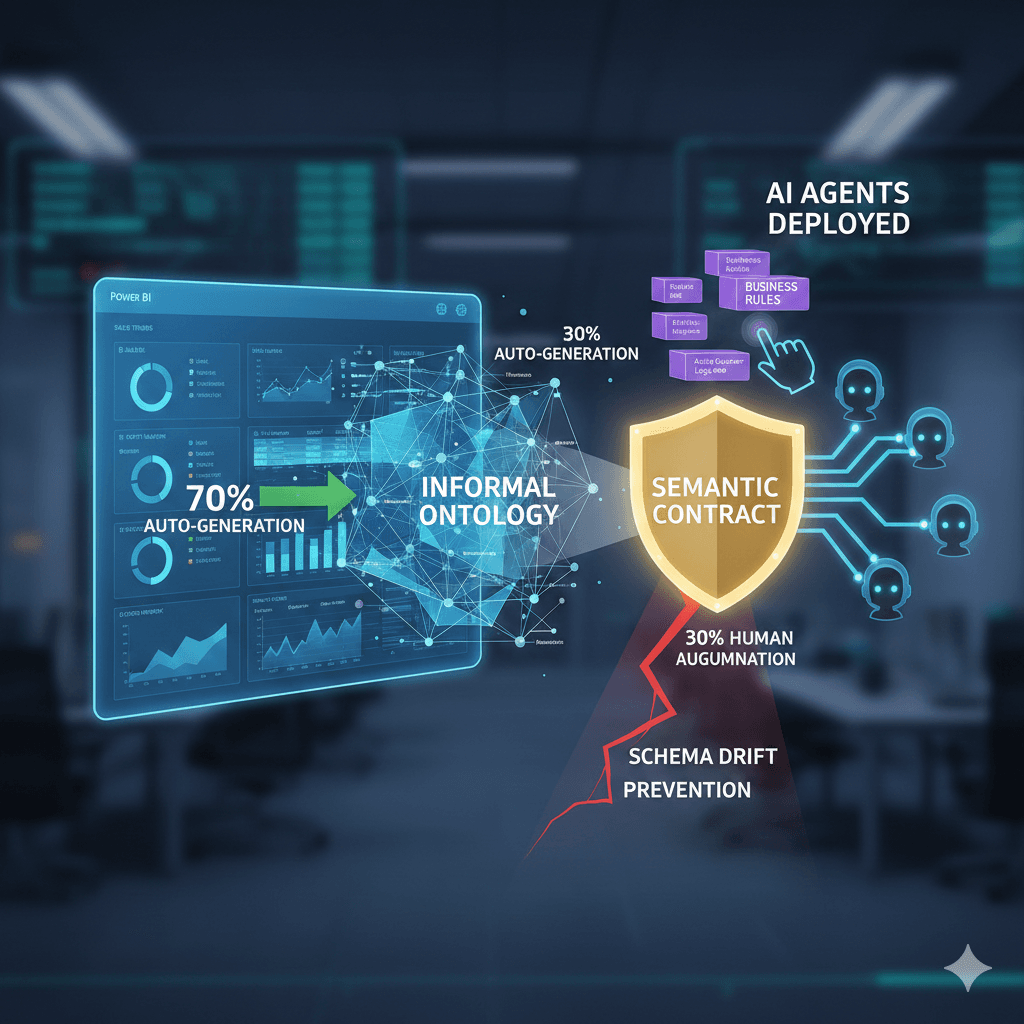

In the modern enterprise, a silent revolution is occurring within the layers of business intelligence. For years, we viewed Power BI as a simple tool for charts and graphs. However, as we move into the era of Large Language Models (LLMs) and autonomous AI agents, a new reality has emerged: your Power BI models are not just reports—they are informal ontologies.
To understand why this matters, we must first define the core concept. In the context of information science, an ontology is a formal way of representing properties, entities, and the relationships between them within a specific domain. It is a “map” of knowledge that tells a machine not just what data exists, but what that data means in a real-world business context.
The “Ontology Paradox” lies in the fact that while businesses scramble to build complex AI knowledge graphs from scratch, they often ignore the robust, pre-existing logic already living inside their Power BI semantic models.
Microsoft’s strategic direction is clear: the future of enterprise AI relies on semantic contracts. A semantic contract is a rigorous agreement between data providers and data consumers (like AI agents) that ensures data maintains its meaning and structure across different systems.
When you treat a Power BI model as an ontology, you provide AI agents with a “source of truth.” Without this, AI is prone to “hallucinating” relationships between data points. By anchoring AI in a semantic contract, you ensure that when an agent queries “Profit,” it uses the exact logic defined by the business, not a statistical guess.
The breakthrough insight in this framework is the 70% auto-generation capability.
By programmatically extracting the structure of existing Power BI dashboards—tables, columns, and relationships—we can automatically generate 70% of a formal ontology. This removes the “blank page” problem that kills most AI projects.
However, the remaining 30% (Business Rules) is where the human element remains vital. This 30% consists of:
Complex DAX measures.
Specific business definitions (e.g., “What constitutes an ‘active’ customer?”).
Hierarchical nuances unique to your organization.
By automating the structural heavy lifting, data architects can focus exclusively on refining these critical business rules.
In data engineering, schema drift occurs when source databases change—a column is renamed, a table is deleted, or a data type is altered—without notifying downstream systems. In an AI-driven environment, schema drift is catastrophic; it causes AI agents to make decisions based on broken or misinterpreted data.
Industry estimates suggest that undetected data errors can cost large enterprises upwards of $4.6M annually in wasted labor and poor decision-making. By using ontologies as a detection layer, we can implement schema drift prevention. When the underlying data deviates from the “contract” defined in the ontology, the system flags the error immediately, stopping the AI before it acts on false information.
The ultimate goal of this architecture is the deployment of AI agents with semantic contracts. These are not just chatbots; they are autonomous workers capable of navigating your enterprise data with 100% accuracy.
By following this methodology, you can:
Extract: Pull the informal ontology from your current Power BI environment.
Augment: Add the missing 30% of business logic.
Protect: Set up drift detection to maintain the integrity of the contract.
Deploy: Connect your AI agents to this governed knowledge layer.
The Power BI Ontology Paradox reminds us that the tools for the future of AI are already in our hands. We don’t need more data; we need to formalize the meaning of the data we already have.
